Lighting
Outdoor Christmas Lights Guide: Warm White vs Cool White, Timers, and Safety
Lighting is what makes a porch glow on a December evening. Here's how to choose the right color, style, and timer, and how to put lights up safely.
This post contains affiliate links. If you shop through them, I may earn a small commission at no extra cost to you. Product links go to retailer search results so you can compare current options; prices and availability vary. Read the full disclosure.
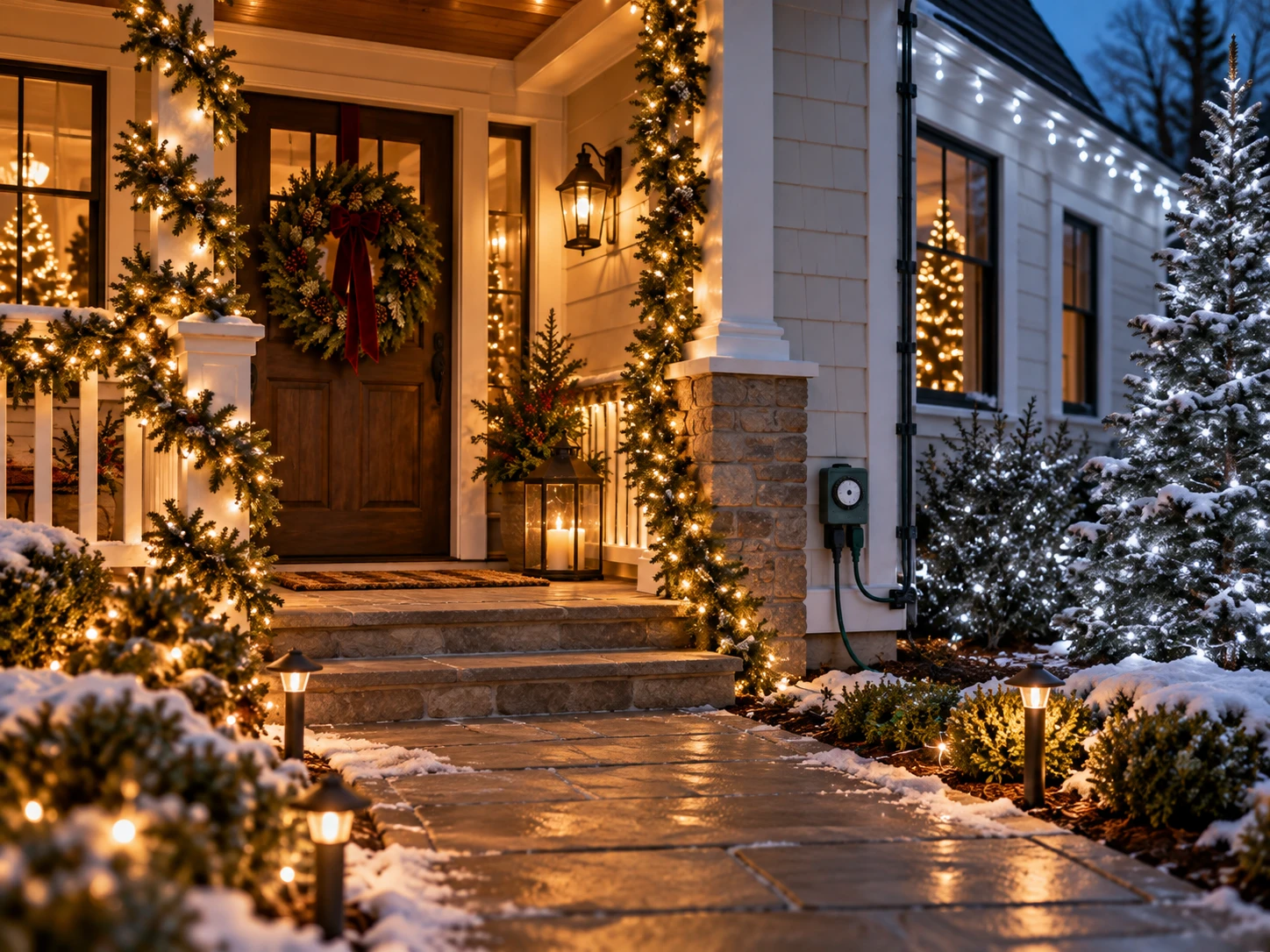
In December, most people see your porch after dark. That makes lighting the most important decor decision you'll make, more than any wreath or garland. The right lights make a porch look warm and welcoming; the wrong ones can make even beautiful greenery look harsh.
This guide covers the choices that matter most (color, bulb type, and style), how to automate everything with timers, and general safety basics for outdoor lights. It's general information, not a substitute for the instructions that come with your lights or advice from a licensed electrician.
Warm white vs cool white
"White" Christmas lights come in a range of color temperatures, measured in kelvins (K). Lower numbers look warmer and more golden; higher numbers look cooler and bluer.
| Label you'll see | Typical look | Best for |
|---|---|---|
| Warm white / soft white (about 2,700–3,000K) | Golden, candle-like glow, similar to classic incandescent bulbs | Traditional, cozy, and natural looks; greenery, wood, brick, and red or gold accents |
| Cool white (about 5,000K and up) | Crisp, bright, slightly blue | Icy, modern, or "winter wonderland" looks; silver, white, and blue palettes |
Exact numbers vary by brand, so if you care about matching, check the product description for a kelvin rating and buy the same line for every area of the porch.
Which should you choose?
- For a cozy, classic porch, warm white is the safe bet. It flatters greenery and makes a home look lived-in and inviting.
- For a frosty, modern look, cool white pairs well with white birch, silver, and blue-gray tones.
- Whatever you choose, don't mix them. Warm and cool white side by side makes both look off. Consistency is what makes a display look polished.
LED vs incandescent
Most lights sold today are LED, and for most porches they're the practical choice. Compared with traditional incandescent mini lights, LEDs generally:
- Use much less electricity, which also means you can usually connect more strands end to end (always follow the package limit).
- Run cooler to the touch.
- Last longer and are often more durable, with plastic bulbs instead of glass.
Some people prefer the softer, warmer glow of incandescent bulbs. If that's you, look for LEDs labeled "warm white" with a low kelvin rating, which get much closer to that look. Don't connect LED and incandescent strands together; they aren't designed to be mixed.
Bulb styles and where to use them
- Mini lights: The classic small bulb. Good for wrapping railings, shrubs, and garland.
- Fairy or micro lights: Tiny bulbs on thin wire. Perfect for weaving through wreaths and planters; often battery powered.
- C7 and C9 bulbs: Larger, retro-style bulbs. They outline rooflines and porch beams and read well from the street.
- Globe lights: Round bulbs that look great draped along a porch ceiling or balcony.
- Net lights: A grid of lights that drapes over shrubs for quick, even coverage.
- Icicle lights: Strands of varying lengths that hang from gutters or porch edges.
Timers, smart plugs, and automation
A timer is the single best upgrade for outdoor lights. Your porch glows every evening without you remembering to plug anything in, and the lights turn off overnight, which saves energy and reduces wear.
Outdoor plug-in timers
Simple mechanical or digital timers plug into an outlet and switch lights on and off at set times. Make sure the timer is specifically rated for outdoor use.
Photocell (dusk-to-dawn) timers
These sense darkness and turn lights on at dusk, then off after a set number of hours. They adjust automatically as days get shorter, which is handy through December.
Outdoor smart plugs
Weather-resistant smart plugs let you control lights from your phone or a voice assistant and set schedules. Check that the plug is rated for outdoor use and that it supports your Wi-Fi setup.
Battery and solar options
No outdoor outlet? Battery lights with built-in timers and solar strands are made for that. Solar works best with good daytime sun; on shady porches or in cloudy weather, battery lights tend to be more dependable. Our small porch guide has more cord-free ideas.
Outdoor lighting safety basics
Holiday lights are safe when they're the right type and used as directed. These general tips are a good starting checklist; always read and follow the manufacturer's instructions for your specific products.
Use lights and cords made for outdoor use
- Check the packaging to be sure lights are labeled for outdoor use (or "indoor/outdoor"). Indoor-only lights aren't built to handle moisture.
- Look for a mark from a recognized testing laboratory, such as UL, ETL, or CSA.
- Use outdoor-rated extension cords and power strips, and choose a cord rated for the load you're plugging in.
Plug into GFCI-protected outlets
Outdoor lights should be plugged into a GFCI (ground-fault circuit interrupter) protected outlet. A GFCI cuts power quickly if it detects a ground fault, which helps protect against shock in wet conditions. Many outdoor outlets have GFCI protection built in (look for "Test" and "Reset" buttons), but some homes, especially older ones, may not. If you're not sure, a licensed electrician can check.
Don't overload
- Follow the package's limit on how many strands can be connected end to end.
- Don't plug too many strands or devices into one outlet or circuit. If a breaker or GFCI keeps tripping, that's a sign to reduce the load or find out why.
- Avoid daisy-chaining extension cords or power strips.
Inspect and install carefully
- Before hanging, check every strand for cracked sockets, frayed or bare wires, and loose connections. Replace damaged sets rather than repairing them with tape.
- Hang lights with plastic clips or hooks designed for lights. Don't nail or staple through wiring.
- Keep plugs and connections off the ground and out of puddles and snow; weatherproof covers help.
- Don't run cords through windows or doors, where they can be pinched, or across walkways, where they become tripping hazards.
- Be careful on ladders: set them on firm, level ground, keep three points of contact, have someone steady the ladder, and stay well away from overhead power lines.
Turn them off when you're away or asleep
A timer makes this automatic. Turning lights off overnight and when no one's home is a simple habit that saves energy and reduces risk.
Take them down after the season
Holiday lights aren't meant to stay up year-round. Sun, weather, and squirrels wear them out. Take them down when the season ends, and store them loosely wrapped in a dry place so they're in good shape next year.
A quick porch lighting plan
- Pick one color temperature (warm white for most porches) and stick with it.
- Light the door first: a lit wreath or garland draws the eye to the entry.
- Add glow at different heights: lanterns on the floor, garland at eye level, lights along the roofline or porch ceiling.
- Put everything on a timer so it runs from dusk until bedtime.
- Do a safety check before and during the season.
Next step: Once your lighting is set, browse 25 Christmas front porch ideas for wreaths, garland, and lanterns to light up.